November 24, 2026

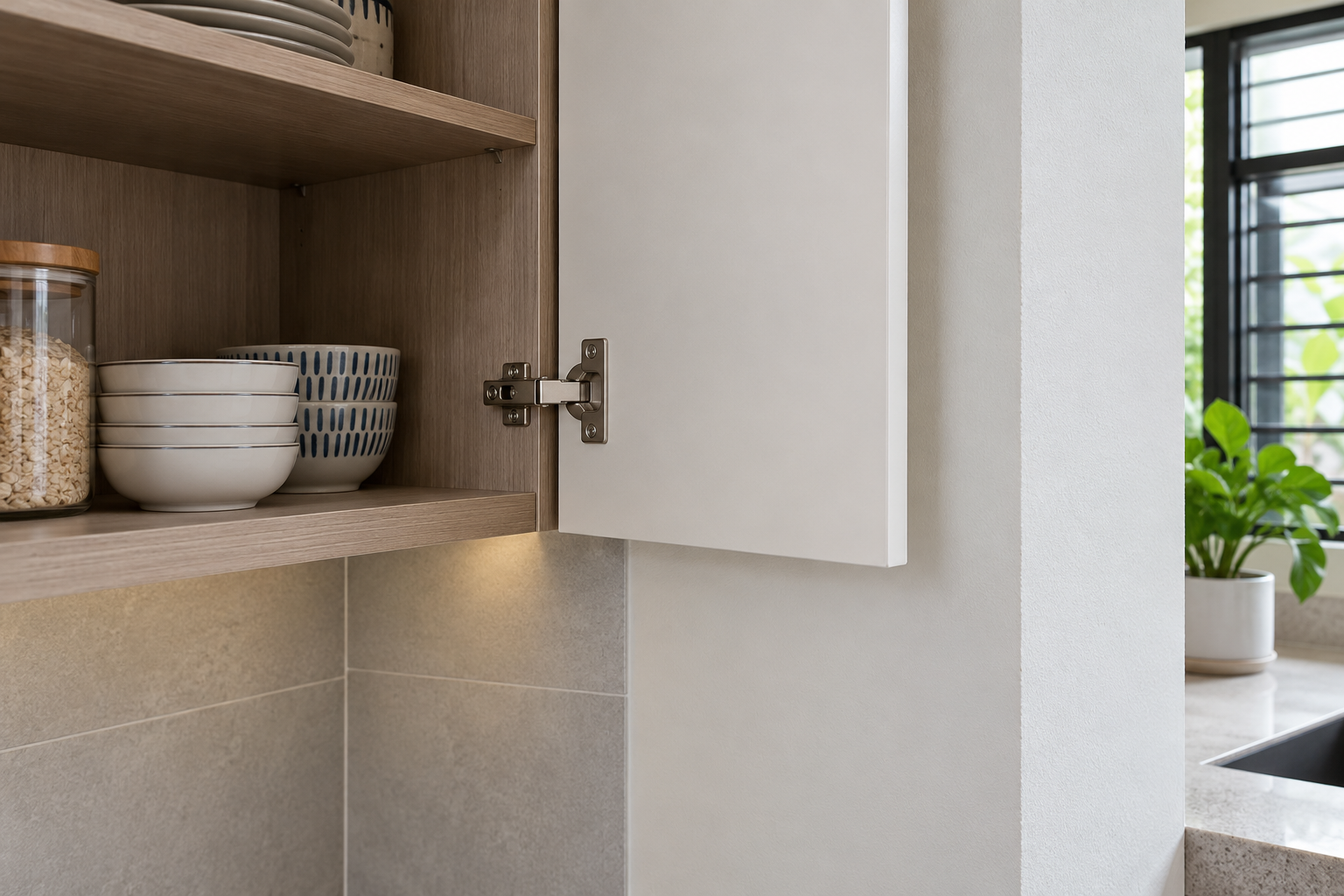
Before approving a cabinet hinge arrangement, check what is beside the door and how you need to reach the contents. Ask the supplier to review the door movement against nearby walls, appliances and other fronts, then select hardware using the actual product specifications.
For a first home in KL or Selangor, a hinge may seem like a minor accessory. Its intended opening should be discussed with the whole cabinet layout, especially at the end of a run or beside another opening.
Include adjacent walls, handles, appliance fronts and neighbouring cabinet doors in the drawing or photographs. Mark which openings may be used at the same time. Do not judge the hinge from an isolated cabinet elevation that omits the items around it.
Explain any existing clash in ordinary-use terms: the handle touches the wall, or the door prevents comfortable access to a shelf. Avoid forcing a door beyond its normal movement or attempting to alter the hinge yourself to demonstrate the problem.
Ask whether the proposed door movement gives the required access to shelves, drawers or accessories inside. A door stopping short may avoid one collision while leaving a different access question. Have the supplier review both rather than choosing hardware from a single angle number.
Blum’s guidance on opening-angle stops discusses specific stops for specific hinge models to address collisions. This supports asking about compatible hardware; it is not a generic instruction to add a stop to any hinge or to install one yourself.
An example concern might be a tall pantry door beside a wall with an internal pull-out behind it. Ask the supplier to confirm the complete opening and access arrangement rather than assuming the widest available hinge is automatically the best choice.
Discuss that detail as part of the custom cabinetry proposal. If an appliance or neighbouring cabinet changes, have the affected door arrangement reviewed again. A hardware decision made for an earlier layout should not be carried forward without checking.
No. The suitable arrangement depends on nearby objects, the contents, the door and the actual hardware system. Ask the supplier to explain how the proposed selection supports your use and avoids identified clashes, using the relevant product specifications.
Send the cabinet location and clear surrounding photos through Terraflare’s contact page.